
Relying on a single provider isn’t efficient. It’s fragile.
When that one source underperforms, slows down, or lets fraud slip through:
- Your entire dataset is exposed
- You lose the ability to benchmark quality
- Field timelines stall
- You have no leverage to pivot
That’s not a sampling strategy. That’s concentration risk.
The strongest quantitative projects are built on intentional diversification.
A multi-source approach allows you to:
- Cross-validate quality in real time
- Detect anomalies before they scale
- Reduce audience and panel bias
- Maintain field speed even if one supplier falters
- Remove underperforming sources without jeopardizing the study
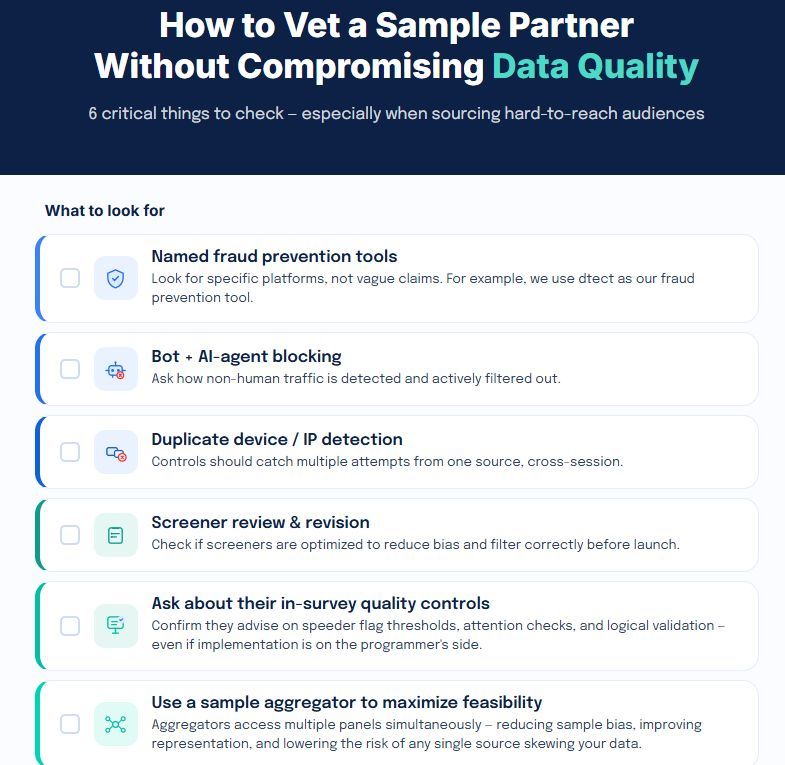
This is exactly why a structured sample aggregation model matters.
When projects run through a centralized aggregator, you’re not managing vendors — you’re managing outcomes. One point of contact. Multiple vetted sources. Continuous quality oversight.
We’ve stepped into projects mid-field and stabilized them simply by reallocating volume across sources.
We’ve also seen studies collapse because everything was tied to a single pipeline.
Diversification isn’t complexity. It’s control.
How many independent sample sources are behind your last study?